Sunday, July 22, 2012

Pandora and Eve


I'm posting an essay I wrote - assigned for school, as will be obvious, but nonetheless I did write opinions that were in fact my own and therefore are worth posting.  This was written when I was first starting freshman year of college after two gap years so be kind.


A little explanation is necessary before you read.

Using three very specific texts, namely Eve's mention in the second and third chapters of the Bible's Genesis and Pandora's mention in Hesiod's Theogony, lines 507-631, and Hesiod's Works and Days lines 42-100ish, we were to compare Pandora and Eve.  However, we were strictly to avoid thinking of Pandora  in the sense of the well-known myth - her being forbidden to open a box, which out of curiosity she opens and it turns out to have all the bad things in it.  Apparently though this tale is widespread there is no ancient primary source that mentions anything like it, other than she opened a cask at some point, and therefore our beloved legend must be some sort of modern development.

Thus our modern minds would be especially tempted to have an Eve-like interpretation of Pandora off the bat - curiosity leading to the downfall of man, etc., which is hardly the way to approach the actual proof of period views of these ladies.

(Harry Bates - Pandora, 1891, front 
- on temporary display at Tate Britain, August 2010)

At any rate, this essay is strictly the interpretation of texts, not involving much outside knowledge of culture, and with no other scholarly sources.

Here are links to the texts if you wish to read or refer to them at any point -

these aren't the translations I used, but I don't think I can legally share those with you, and these are close enough of course:

The Bible: Genesis chapters 2 and 3
Hesiod Theogony starting line 507
Hesiod Works and Days starting line 42

Yay! Here we go.

Pandora and Eve; Femmes Fatales of Old


In the creation of Woman the Hebrews and Greeks saw great potential for explaining the dynamics between the sexes; both stories call to question the function of woman with reference to Man and God. In not asking the reverse – what function man and god has to woman - Pandora and Eve are both rendered second class citizens in their own creation stories. Pandora and Eve, through the weakness indulgence creates, are both sources of all womanhood and the doom of mankind; and, as opposed to the natural creation of Man out of dust (whether it be the Hebrew God or the Greek Prometheus), these original women are created differently and for a different and specific purpose, as an afterthought – certainly not part of an original plan – , and solely for man. However this is where there likenesses end; for the Hebrew Bible goes to lengths to give Eve enough autonomy to decide to take of the forbidden fruit, and, though it brands woman forever as the original sinner, in so doing she must be made a person to be capable of such an act. With Hesiod’s Pandora, she is a curse hidden as a gift that was meant to be returned, and that is all; she is a mere object and burden and her purpose and self are one in the same.

Eve After the Fall, Alexandre Cabanel

Neither Pandora nor Eve was born. They were created; after man and for Man, through a divine imperative. Made through a completely different process than Man, in a very specific and graphic way, they are in a sense rendered less natural than Man and less human. Consider Pandora’s second name after “Woman” – “manufactured maiden” (Theogony 510-515) and Eve’s first description by Man as “bone of my bones/ and flesh of my flesh” (2:23); the picture of the Hebrew God effectively drugging Man in order to extract the necessary body parts to assemble Eve feels more contrived than sacred: "the rib that the Lord God had taken from the man he made into a woman" (2:22). This distinction between Woman and Man leads to the concept of different roles; of weaknesses in particular, perhaps through unconventional assemblage. Both Eve and Pandora, through their relationship with man, bring much “toil” (3:17, Theogony 595-600) to him, to “hurry about [his] work…until the sun/ Goes down” “by the sweat of [his] face” (3:19). As result of her influence over him, he is “cursed” (3:17) – in the case of Pandora, she is literally called “the lovely curse” (Theogony 585-590).

Adam and Eve, Peter Paul Rubens, c. 1597

Though both women are referred to solely though the roles they play, that is where the material difference between them is found. Their names speak of the function assigned to them: “Pandora” meaning “all gifts” – “the gifts which all the gods/ Had given her” (Works and Days 80-85) and “Eve” meaning “living,” “because she was the mother of all living” (3:20). Eve, despite her mistakes, is nonetheless called only a few simple names – “woman” (2:22, 2:23, 3:01, 3:02, 3:04, 3:06, 3:12, 3:13, 3:13, 3:16) “wife” (2:25, 3:08, 3:20, 3:21, 3:17) “Eve” (3:20) and “mother” (3:20). She is a member of the family. She was made because “It is not good that man should be alone;” she is Man’s “helper and partner.” Not so with Pandora. Her name’s meaning is a plural noun; and she herself represents a collection of objects: women. Pandora is called many, many vicious names – “an evil thing for [Man’s] delight” (Works and Days 55-60), “this ruin,” and “this ruin of mankind” (Works and Days 55-60, 80-85) “deep and total trap” (Works and Days 70-75) “Into the image of a modest girl” (Works and Days 70-75); it is made clear she was designed as a false sexual parasite and nothing more – to “fill [her belly] up/ With products of the toil of others” (Theogony 595-600).

Pandora, Jules Joseph Lefebvre

In her entire story in both the Work and Days and Theogony scripts she only commits two verbs: “thrilled” (Theogony 585-590) and “opened” (Works and Days 90-95); the first is the ironically innocent depiction of the a girl as belle of the ball “thrilled by all her pretty trappings”, unaware that she was brought “to a place/ Where gods and men were gathered” in order to “[seize] the mortal men and gods,/ To see the hopeless trap, deadly to men” (Theogony 585-590). In the Works and Days version it is made clear that she is not so naïve and childlike as her first verb would make her appear – for, thanks to Hermes, she has been given “sly manners, the morals of a bitch” “lies and persuasive words and cunning ways” – and, most importantly, Aphrodite’s gift, “painful, strong desire, and body-shattering cares” (Works and Days 60-80). Through these terrible, if passive vices she is made to be the “price for men to pay for fire,/ An evil” (Theogony 570-575), being desirable, irritable, and useless simultaneously; with only enough personality to carry out her second and last verb: “But now the woman opened up the cask, and [scatter] pains and evils among men” (Works and Days 90-95) – that is, disease and death.

Attributed to the Niobid Painter. 
The Creation of Pandora. 
Attic Red Figure, Calyx krater shape. 
Archaic Period. British Museum, London, UK.
Creation of Pandora, interior of Cylix,
470-460 B.C., British Museum, London, England

Eve is guilty of many verbs – “saw” “desired” “took” “ate” and “gave” all appear in the same verse (3:06); likewise she is born naked, whereas Pandora’s very creation is expressed through the applying of clothes: she has “robes” “belt” “necklaces” “wreath” “crown” “flowers into a crown” – all detailed and made by Gods specialized in those fields (Theogony 570-585, Works and Days 60-85). Eve’s lack of adornment emphasizes her person and her actions; Pandora is defined as all adornment; even her “skills” are bestowed upon her by the Gods. Eve speaks; Pandora does not. Though both illustrate the power of indulgence to destroy – Eve partaking of the fruit, Pandora inciting lust –Pandora was specifically created to, and Eve was not. Most importantly, Eve is given punishment, and Pandora is punishment incarnate – Eve is doomed to “desire…for [her] husband” concurrent with “pangs of childbirth” (3:16) whereas Pandora causes man to “[live] all his life/ With never-ending pain inside his heart/ And on his mind” (Theogony 610-615), and to add insult to injury, she (and so saying, all women) is “No help to [men] in poverty/ But ready enough to share with [him] in wealth” (Theogony 590-595). Eve sins (whether arguably to her lesser nature or no), and she suffers consequences; Pandora merely exists as consequence to others.

Illustration for John Milton’s “Paradise Lost“ by Gustave Doré, 1866.

The two famed female figures may both have a reputation as femmes fatales, but they carried out their sentence on mankind in very different fashions; Eve diverting from a chosen path through personal will, Pandora simply in being herself as she was created. They are both cited as the first woman, and both directly or indirectly caused punishment to be inflicted on the whole of man; however the Hebrew account chose to personify where the Greeks objectify. Neither can really make proud any conventionally modern feminist group; but perhaps the ideology behind Eve can more clearly exemplify the Hebrew view of woman was mother and wife first, sinner second.

~end of essay~

Thursday, July 19, 2012

Look Out for Mermaids, Miniseries, and More!


In my last post, dated August 6th, 2011, I un-birthday wished my next post would be in less than a year.  HAZAH therefore because today is July 19th, 2012!  Not quite a year!  Take THAT!


This time I won't promise regular posts - I'll just post regularly, sans promises.  But enough of that.  On to feminism.

  • With "Murder, She Wrote" now on Netflix instant play, I'm returning to a childhood refuge of mine, so Jessica Fletcher will be a topic of discussion.  Especially as it has awakened the sleuth-enthiusiast in me, so a little Sherlock movie series/ BBC series talk might be sprinkled here and there!


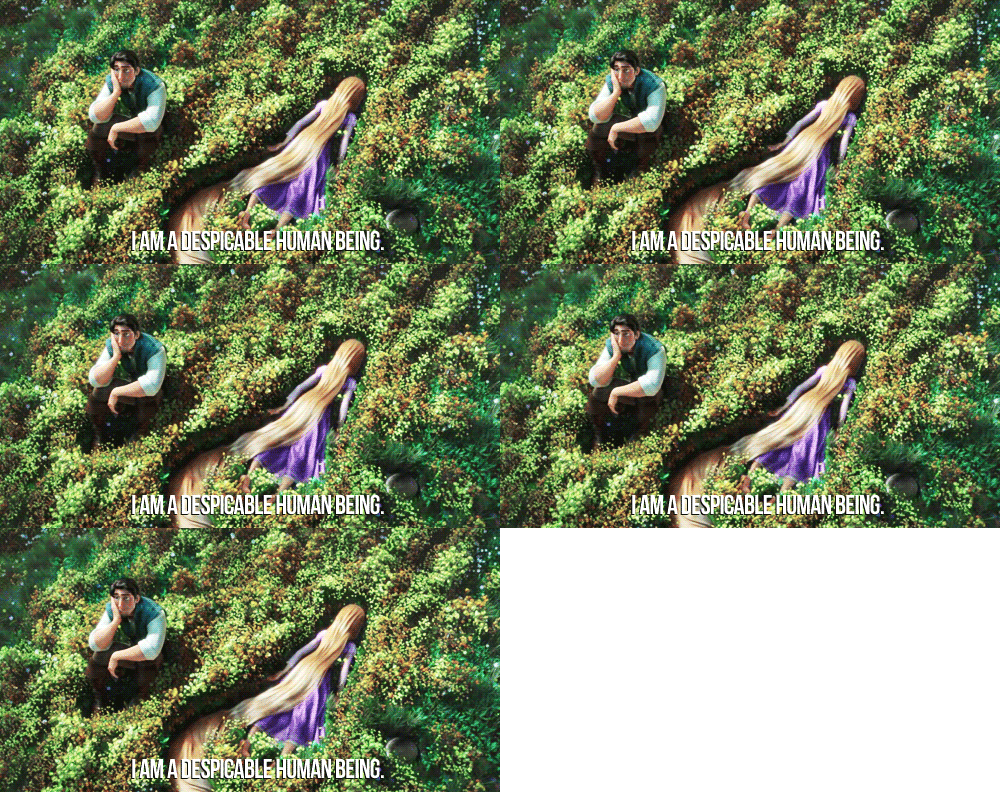
  • I've barely scratched the surface of my obsession with Disney's adaptation of Rapunzel: Tangled, so wait till you see just how much I have to say about that - and the Rapunzel fairy tale in general!  (and hopefully I'll get around to comparing it with my favorite fairy tale, Hans Christian Andersen's and Disney's Little Mermaid)


  • Pixar's Brave has now hit theaters, and I will cover my opinion, and my opinion of the critic's opinions.


  • Then there's this cartoon series called "The Legend of Korra" - interesting in it's design of female characters, especially when juxtaposed to the writing of the original series it is a sequel to, "Avatar: the Last Airbender."


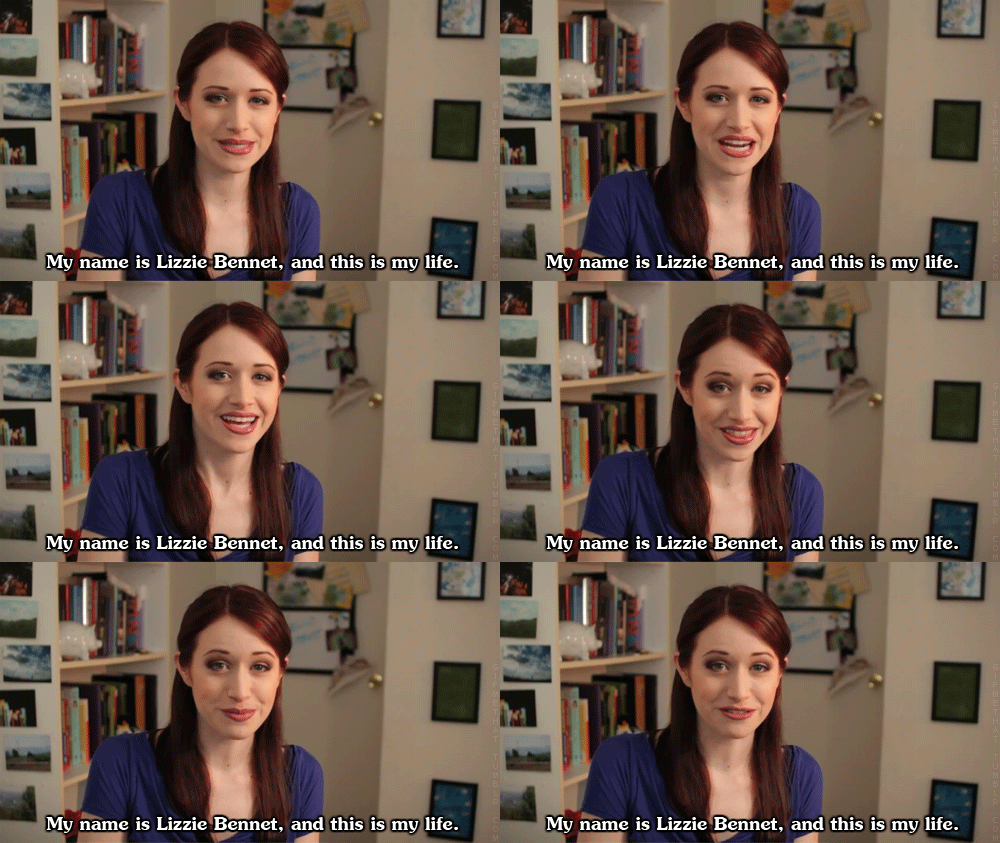
  • And let's not forget - the Austen-obsessed 90's may be over, but there's still a new hoppin' adaptation that Austenites are buzzin' about!  "The Lizzie Bennet Diaries" - a Vlog adaptation of Pride and Prejudice!  Let's not forget that there has never been a Vlog adaptation of any book before, and since it has been 7 years since the last Pride and Prejudice adaptation, we're all ready for some more Lizzie and Darcy.  


  • Ah yes and I almost forgot my new favorite web series!  Barbie: Life in the Dreamhouse!  An official series by Mattel that is an exquisite balance of parody, propaganda, and positivity!  Here is the first episode:


  • And!  there's a mega-post I worked on for two years that really should be split up and posted by now, so keep a look out for that.  It's called "Subli-mer-inal Images and How We Channel Them."

Well!  That's certainly a lot of material to cover!  Let's get going!

As soon as I publish each topic, I'll include the links in the above list, to make everything easy for you readers!

P.S. A little explanation as to the time between posts: I'm a bit of an anxious perfectionist, and could never click the "publish" button.


and then I'd be all


But never fear!  I got this cool idea to blog on tumblr for a while, and get the hang of instant-blogging, to sort of counteract the hesitancy, and have some fun figuring out how that completely different style of blogging works - so yay!


Saturday, August 6, 2011

Hello Again


HELLO AGAIN! !NIAGA OLLEH


It's three months and fifteen days short of a year since my last post! Two New Years ago I posted a photo of Dorothy just stepping onto the yellow brick road as a symbol of my resolve to post more regularly. This time I'm starting out with an image of Dorothy a step further... because I haven't come too far as a person since then but I still like the picture? Whatever it's symbolism.


Ok, so before more excuses, some content.

This fall I am entering college - two years after graduating highschool - and it bears mentioning that my application's personal essay (which I might include here) spoke of my obsession with The Little Mermaid (the ensuing film adaptations, etc.) and its bearing to feminism and multimedia - in short, this blog.

Yes, I have been researching my butt off to find anything on how Hans Christian Andersen's tale has effected our culture in the past 174 years, 4 months and 30 days.


Surprisingly, it's a lot of work. Nothing much organized is out there, apart from e-texts and fan sites for Disney's Ariel. My life-long dream has become to create a user-friendly and informative website about "Little Mermaid" culture and history, but for now, I'll give you an idea of what I've dug up.


Here are the adaptations that almost make the list - but don't:


You see, I figure my research isn't your typical picture of historical archiving. Sure, everyone knows that the amount of documents or projects or evidence ever made throughout time on earth is finite. However, the pursuit of finding and exploring and explaining history is a blissedly impossible art - as is pretty cutely analyzed in this book I've been reading, History: a Brief Insight by John. H. Arnold.

But I figure since film was only discovered in the 1920s or something, I have a real fighting chance of finding all the versions of the Little Mermaid ever made (or of knowing some to be lost). See I figure if my generation is in the singular position of knowing black and white photographs means grandma and grandpa (which will never be true again), then film being such a new expression in our minds is likewise a peculiar imprint on our ways of storytelling, or something like that. I don't know I haven't really bothered to think it through.


Anyhow I think the various little mermaid film adaptations have a lot to say about what film-makers try to do as film itself has progressed. Sort of like the mermaid story is the control and the development of film the variable. And since the story itself is about pushing boundaries and crossing mediums, I figure that film is well suited to the story as well.

It's not that simple of course; when you read Hans Christian Andersen's writing you'll notice, I think, that the Little Mermaid herself is very quiet and thoughtful, and that as much of the story lies in her thoughts as in the avant-garde breaking of bonds from mortal water to temporary human to daughters of the air or what have you. This (her silent thoughts and nature) is a very precious element (haha) of the story that is easily lost in film. But that makes it twice as fun! How does an artist who works with film deal with that?

I have a feeling this is one of the main concerns that led Disney to fundamentally change the personality of The Little Mermaid in their adaptation. Ariel wants the prince as much as Hans Christian Andersen's Little Mermaid does - the unrelenting concept of "want" is still there - but they made her more fierce, more smile, more blatantly an embracing figure, and by far more adventurous and assertive. But I'll discuss more of that later if I ever get around to publishing my entry on her.


Then there's the female question (you've probably been wondering when I'd get around to this, since I keep insisting this is a feminist blog). Is it the woman needs a man, or is it that people think it is unfeminine for a woman to chase a man? Is it a story about becoming a woman - since literally the "little" mermaid was not only young and lacking full maturity, but was in fact inhuman and therefore in-woman for a great part of the story. Is there a latent implication that it is the province of women to dream from the sidelines, or hope without hope, or love without love, or fight without success, or yearn without need? For the last one - you've got to admit she was a princess of the ocean. She had it made. Why did she want more? (Of course there was that whole, "we don't have a soul" thing but give me a minute I'll get to that.)

But how could it be a latent implication that it is peculiarly a woman trait to yearn unecissarily or dream a vapid dream, since this story was written by a man well known to be shy himself, to have gone through unrequited love himself, unfinished dreams himself (lost career as a singer hellooo), to feel he was a stranger in a new world himself (a writer amongst the gentry, however successful, was at that time in that place still to be a serviceman)?

Of course then there is the rumor - or fact, I haven't read enough - that Hans Christian Andersen had homosexual tendencies so some might say he was getting in touch with his inner woman or something, but that's a whole other can of non-kosher non-politically correct worms, indicating that sexual orientation and sex (gender) are somehow related...


What was I talking about? Oh, my quest with the story, and how it effects and has effected film and people over time. And how I think my quest is especially cool because film is new and - I didn't mention this yet - the story itself is one story from one author, unlike other fairytales. (This isn't completely true in the sense that it was inspired from at least two old folktales I can think of right off the bat - The Legend of Undine and Dvorak's Rusalka, - but run with me here.)

Okay so my opening thoughts were I think these ingredients (mermaid, film, history, woman, writing) are curiously intermingled and that's cool and special.


Okay cool! Done with my short opening remarks. haha.

By the way I haven't included the 1987 Shelley Duvall "Fairy Tale Theatre" version because I haven't been brave enough to try watching it yet - the fan effect to make the hair look like it is underwater looked more like the creatures were trying to have a conversation in a whirlpool. However, I have sources that say it's worth watching so we'll see.


Ok so since my opening remarks were so long I'll make my middle and end remarks nice and short. I want these entries to be shorter so I can post more often.

ooo! I promised more excuses. Here we go. Why I haven't posted but still keep proudly calling myself a blogger.


I've continued to obsess and collect all information about Disney's Tangled (and how it's discussed and portrayed in the media of course).

(a revised edition of a Disney Princess book that includes Rapunzel. One of the new 2D designs for her in the Disney Princess consumer product line. I love how all the princesses are dolled up past recognition XD)

(left to right: older, newer)


(left to right: new, newer)

I think I might have mentioned a while back that I find Rapunzel the second most important fairy tale behind the Little Mermaid when it comes to issues with women and issues with the Self. So the most famous feature-length film adaptation has become a source of major fascination. Plus the way it was made, technologically, is about the marrying of artistic vision and technology, perhaps for the first time at this scale ever ever ever, so that as you might suspect is very personal to me.

(concept art by Claire Keane)

Plus I figure every five years or so you should find something to be fiercely addicted to and obsessed with. For your health and vitality or something.

Though I've kind of been losing sleep and seeing less people because of it, so maybe I should rethink that.


(fan poster-thing made by me. funny right?)

Starting September of Last Year, I have been trying to write a comprehensive series of entries on this movie - that was two months before it came out. The first entry was "Tangled - Can I Marry This Movie?" For these entries I uploaded One Hundred and Thirty-Four images - detailed screencaps from trailers to discuss the choice of the depiction of her body, the tower, etc. Hopefully I'll get around to touching those entries up.


Here's an example of the level of detail my scrutiny of Tangled has become.


The top moving image is from the first trailer. The lower image is from the movie (I had to flip the image so they'd be easier to compare). The trailers and choice of promotion focal points or whatever were very controversial, because Rapunzel was barely seen in them and the character Gothel was left a mystery - some thought the main character was going to be a glib theif amongst a shadow of a Shrek film. It was NOT, but the change of title from "Rapunzel" to "Tangled" made it seem like Disney was pandering to audiences to try and lure unsuspecting little boys to watch a princess film. At least that's what lots of critics said.

Anyhow you'll notice annoyed Rapunzel from the trailer's hair is differently shaped and colored from annoyed Rapunzel from the movie, and her lips pout more (perhaps to exaggerate the modern sexiness they wanted to get across?). Trailer Rapunzel's hair frames her face more and there are more distinctive highlights of pink. Not to mention they chose to enhance the color scheme to maybe make the trailer "pop" more. Also movie Rapunzel smiles in a moment of confusion before she raises her frying pan in a huff. Were they shortening the clip for trailer time purposes or did they want to emphasize the "spunk" of the character in the commercial?

Maybe they made these changes because they were still fine-tuning her character. Maybe the hair is different and pinker in the trailer because they were still debating how distracting it would be for 70 feet of screen hair to have pink highlights.

Maybe I should be doing better things with my time. haha.

(concept art by Glen Keane, current desktop picture)

But seriously, food for thought. Some animator made these changes and they did it because they cared, it's a career decision for them. The more I learn about Disney the more I realize how damn seriously they take themselves and their work. And as a non-diagnosed obsessive compulsive and workaholic I like that in an art company.

P.S. - This next moving .gif was always my favorite part of the trailer. It still feels a lot like the finished Rapunzel. A part of me wishes it made it to the movie, but I see why they couldn't fit it in (she'd have to be too comfortable with a strange human's presence in her isolated tower too fast and THAT doesn't fit the character).


By the way I made this moving gif. image to discuss how they squished her body and the use of under-eyelids for expression we are accustomed to see in 2D animation -
- as well as a pontificating discussion of what they might do with her (Rapunzel's) sexuality. yeah.

Of course the eyelid thing for these two characters are especially similar because the animation for both Ariel and Rapunzel were headed by Glen Keane.


- Okay so now I'll classify that as my MIDDLE remark(s). Now for the end remarks.

Um, I like to watch films with tea and pretend they are pouring coffee...


...I've been thinking I should try to articulate why the show Daria is appealing beyond the solidarity for the intelligent female shut-in, not that that's nothing... if you don't know the show, I'll clue you in...


... I've noticed the beginning of the Hobbit (I'm rereading it) makes you quite hungry (all that talk of cold chicken and pickles and seed-cake and coffee and cheese and mince-pie).

... did I forget to mention I've spent as much as $70 in the past week trying to purchase from Amazon Japan certain Little Mermaids I have been looking for, neither of which were what I wanted, one of which was borderline bootleg of terribly done cheap animation? UGH the risks and hardships one takes for the cause... I did find the original audio for one of the Japanese ones so the last month hasn't been a total loss...


... ooo and I've been working on videos. Animated Fan Music Videos. One which I hope will be done very soon, is my attempt to emphasize the darker tones of Disney's Rapunzel and the story of Rapunzel in general through Emelie Autumn's "Lady Shalott," some color scheme changes, and some playful editing... I'll keep you posted on that...

...Futurama's back for another few seasons, which is great. I should do a Leela entry... they really push the boundaries of her likability, which I really admire... those writers have balls... (haha stereotypical male metaphor on feminist blog!)

Futurama Thursdays 10/9c Get The Ball
Bender plays fetch with Mr. Peppy, Fry's alien pet. Video Clip, Airdate 8/11/2011Comedy Central
grrrr I want one of those as a pet.

... and with that cute little tidbit I think I will leave you. A Very Un-Birthday to you! (yeah I went there.)

Hopefully a new post sooner than a year from now! (It's my un-birthday wish.)